As biogas gains importance as an energy resource, the demands placed on the systems responsible for its treatment and conditioning also increase.
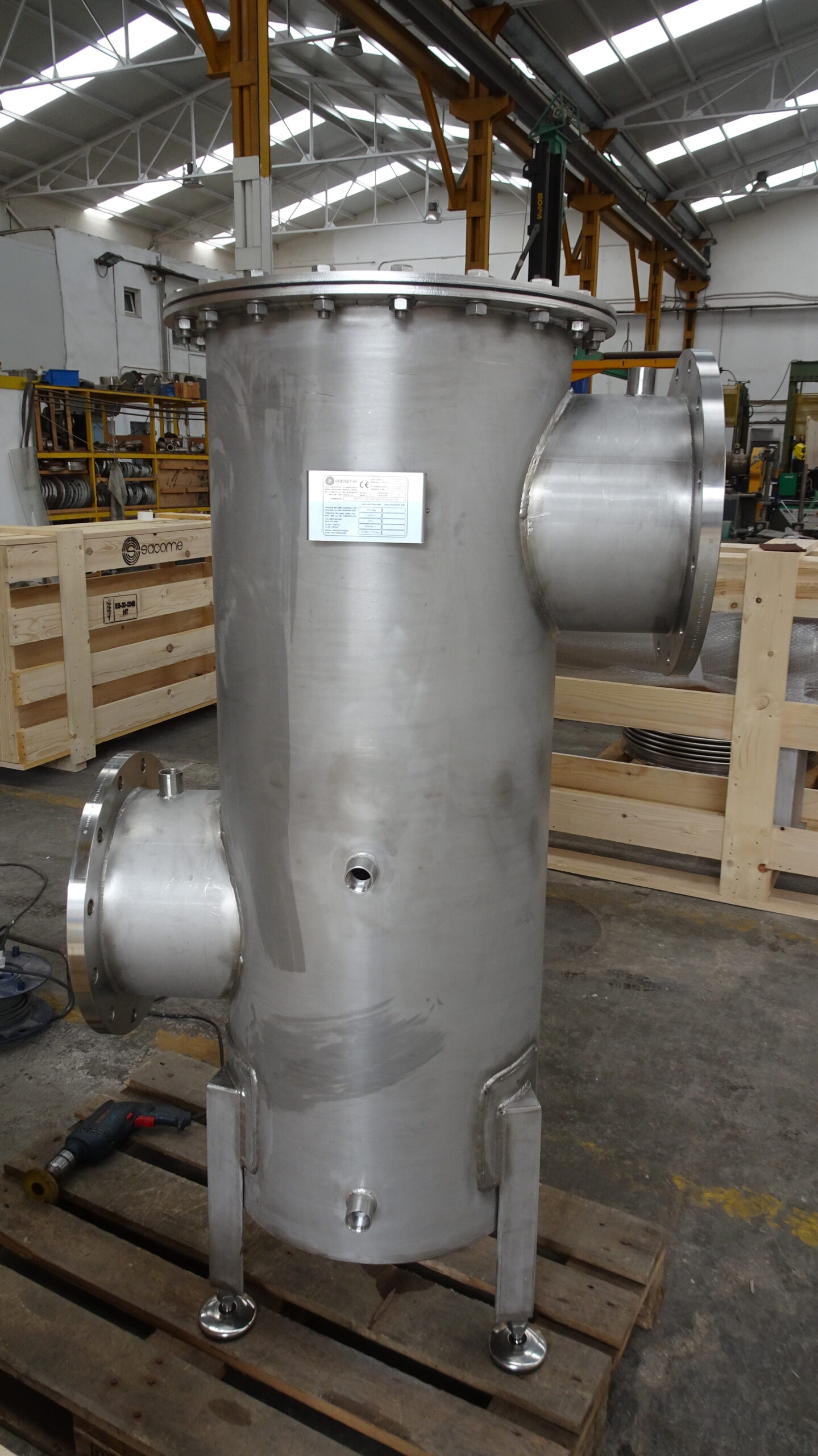
A facility for the selective collection, recycling, and treatment of municipal waste contacted SACOME to improve its biogas conditioning system. The client had a tubular heat exchanger connected to a droplet separator tank, both supplied by another vendor, whose performance was not meeting expectations.
After replicating the operating parameters of the existing equipment, SACOME’s technicians proposed a series of improvements to achieve the required performance:
Increasing the heat exchange surface area by lengthening the inner tubes while ensuring that the pressure drop in the biogas did not become excessive.
Resizing the glycol water inlet and outlet connections in the housing, as the existing diameter limited the heat exchange capacity.
Incorporation of a metal expansion joint in the exchanger housing. Absent in the previous unit, it absorbs the differential expansions between the biogas and the glycol water during start-up and shutdown cycles, thereby protecting the tube-to-plate welds.
Increase in the height of the droplet separator to improve condensation and better adapt its volume to the actual needs of the application.
Thanks to SACOME’s experience in biogas treatment using I-TFM-I tubular heat exchangers, the proposed new design does meet the customer’s requirements.
Improving performance also means knowing where to act.